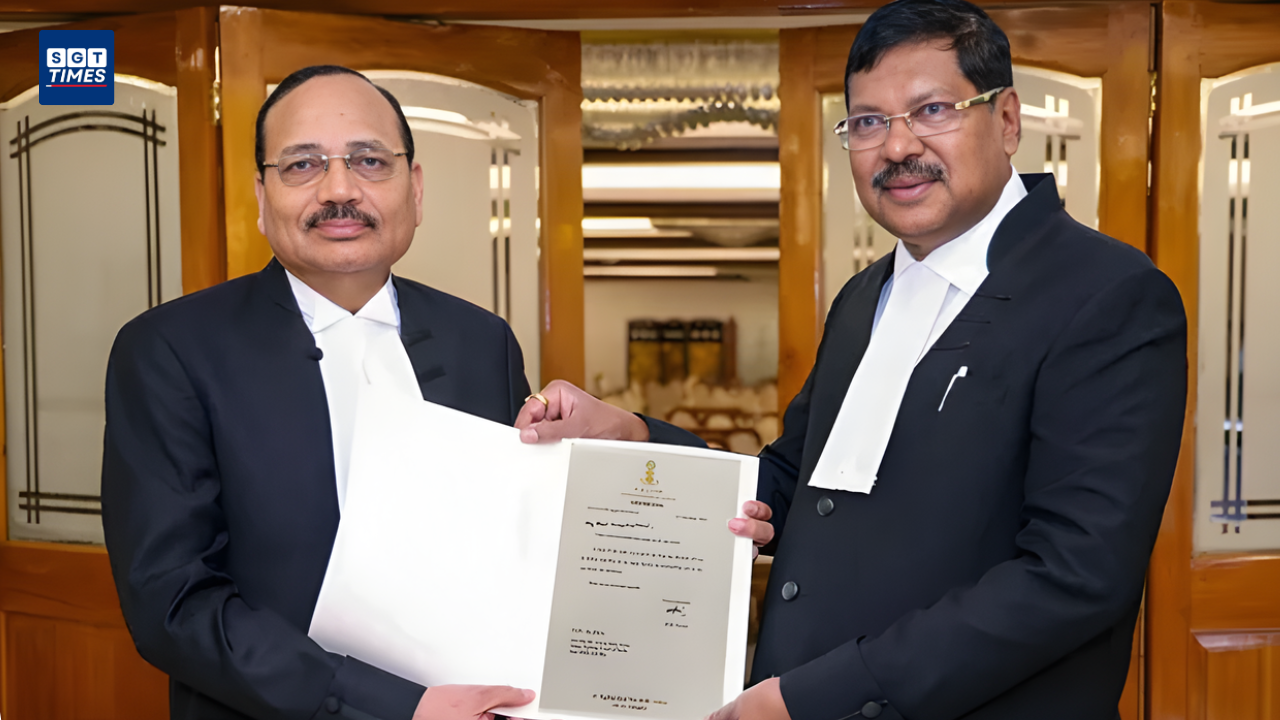
Justice Surya Kant Takes Oath as India’s 53rd Chief Justice
Justice Surya Kant was sworn in today as the 53rd Chief Justice of India (CJI) at Rashtrapati Bhavan. President Droupadi Murmu administered the oath of office, marking the beginning of Justice Kant’s tenure, which will last until February 9, 2027, when he reaches the age of 65. He succeeds Justice B.R. Gavai, who stepped down from the position on Sunday.
Justice Surya Kant’s appointment was officially announced on October 30, following the recommendation of then Chief Justice Bhushan R. Gavai. Upholding constitutional tradition, Justice Gavai named the senior-most judge of the Supreme Court as his successor. Justice Kant now assumes the country’s highest judicial position with a clear focus on strengthening the justice delivery system.
Born on February 10, 1962, in a middle-class family in Haryana, Justice Kant began his legal career by practicing in Hisar in 1984 before moving to Chandigarh. Over the years, he has handled significant constitutional, service, and civil matters and represented various major institutions, including universities, banks, and state bodies. In July 2000, he became the youngest Advocate General of Haryana, and the following year, he was designated a senior advocate.
Justice Kant was appointed as a permanent judge of the Punjab and Haryana High Court in January 2004. He later served as the Chief Justice of the Himachal Pradesh High Court from October 2018 until his elevation to the Supreme Court in May 2019. Since November 2024, he has also been the Chairman of the Supreme Court Legal Services Committee.
In a media interaction ahead of assuming charge, Justice Surya Kant emphasized that reducing judicial backlog would be his top priority. According to the National Judicial Data Grid, India currently faces a massive backlog of over 5.29 crore cases across all courts. Justice Kant stated that his initial focus would be to collaborate with all High Courts to understand the issues affecting district and subordinate courts.
He also announced that Constitution Benches comprising five, seven, and nine judges would soon be constituted to hear long-pending matters. Stressing the importance of alternative dispute resolution, he advocated for strengthening mediation—especially community mediation—to reduce disputes between states and between the Centre and states.
Regarding the potential use of artificial intelligence in the judiciary, Justice Kant mentioned that AI could assist with procedural matters but noted that “everyone wants their case to be decided by a judge.”
Justice Surya Kant’s tenure is expected to emphasize efficiency, inclusion, and the modernization of judicial mechanisms across India.